The short answerGuiyang is the hub, and the high-speed lines now reach Anshun, Kaili and Libo directly — which is what changed Guizhou from a hard province to a straightforward one in the last few years.
Classic itineraries
Five days: falls and a Miao village
5 days · 4 nights
A first trip, all by rail
- Day 1Land in Guiyang, evening in the old town.
- Day 2Rail to Anshun, then Huangguoshu — the falls and the cave behind them. Back to Guiyang or stay in Anshun.
- Day 3Rail to Kaili, then the road to Xijiang for the night, inside the village.
- Day 4Xijiang in the morning before the coaches, then back towards Kaili and Guiyang.
- Day 5Guiyang, then out.
Seven days: add Libo
7 days · 6 nights
The route we would choose
- Day 1–4As above, ending in Kaili.
- Day 5Rail south to Libo, Xiaoqikong in the afternoon.
- Day 6Libo in the morning, then north-west towards Zhaoxing.
- Day 7Zhaoxing, then out via Guiyang or on into Guangxi.
Nine days: the village trail
9 days · 8 nights
The signature route, for travellers with time
- Day 1–3Guiyang, Anshun and Huangguoshu.
- Day 4–5Kaili and Xijiang, then the smaller Miao villages that see almost no one.
- Day 6–7Zhaoxing and the Dong villages around it.
- Day 8Fanjingshan — cable car up, and a night at the base.
- Day 9Back to Guiyang and out.
These are shapes we build regularly, not fixed departures. Move a day, drop a city, add a night — the route is rewritten around your dates, and quoted in writing before anything is booked.
What you will actually see
Huangguoshu Falls (黄果树瀑布)77.8 m high and 101 m wide, with a path that runs behind the curtain of water and a cave in the middle of it. The whole scenic area is several waterfalls, not one; allow a full day.
Xijiang Miao Village (千户苗寨)A thousand households of wooden stilt houses stacked up a hillside, and the largest Miao settlement in the country. It is staged in places and inhabited everywhere else — walk uphill past the shops.
Libo Xiaoqikong (荔波小七孔)A karst valley of turquoise water, stone bridges and forest, on the road to Guangxi. The seven-arch bridge is the postcard; the water colour is the reason people come back.
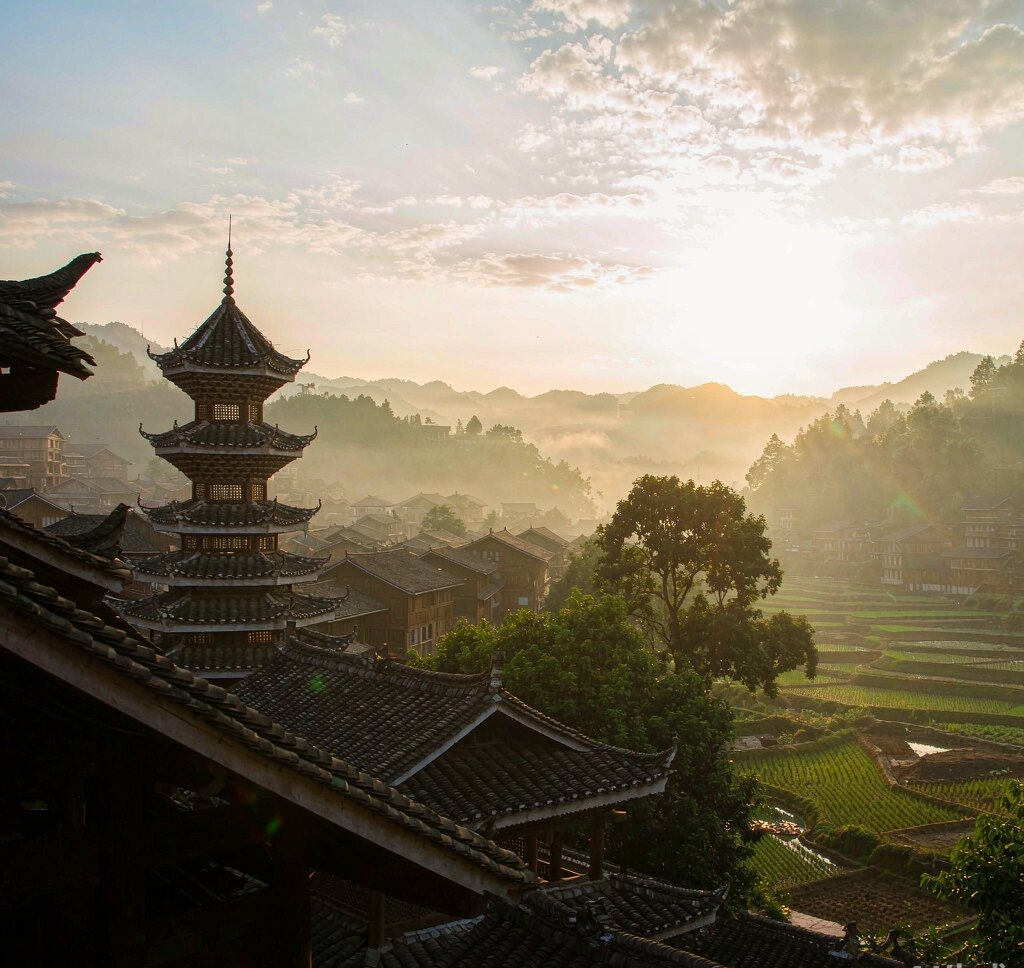
Zhaoxing Dong Village (胇兴侗寨)Five drum towers, five wind-and-rain bridges, and a Dong community that still runs on clan lines. The evening song performance is worth staying for, and it is not a tourist show in the usual sense.
Fanjingshan (梵净山)A UNESCO-listed 2,570 m peak with an ancient temple on the summit and a cable car most of the way. Cloud forest, and one of the few places in China with a genuine endemic species list.
Getting there and around
- Guiyang Longdongbao (KWE) is the province’s airport, with connections through most major Chinese hubs.
- The high-speed lines are new and fast: Guiyang to Anshun about 30 minutes, to Kaili about 40, to Libo about 90 minutes.
- Distances that look short on the map are not: Xijiang is an hour by road from Kaili, and Zhaoxing is another two to three hours from there.
- Guizhou is covered in full by the 240-hour visa-free transit policy, entered at a designated port — Guiyang is the obvious one for this province.
Before you go
Autumn, and the ginkgoSeptember to November is the driest and easiest stretch: more sun than summer, the falls still running, and the villages cool but not yet cold. From late October the old ginkgo trees in the Bouyei villages around Guiyang turn, and the higher the village the later it peaks — some of these trees are said to be over a thousand years old. None of those villages has workable public transport; that is a car-and-driver day, not a bus day.
Festivals drive the calendarMiao New Year, the Sisters’ Meal festival and the Dong singing festival move with the lunar calendar and vary by village. If a festival is the reason for the trip, the dates have to be confirmed village by village.
Rain and roadsApril to June is wet and green, and the waterfalls are at their best. Mountain roads can close for a day after heavy rain; build slack into any transfer over two hours.
Village staysThe best nights in Guizhou are in guesthouses inside the villages, not in Kaili. Hot water and heating are the two things to confirm before booking, in that order.