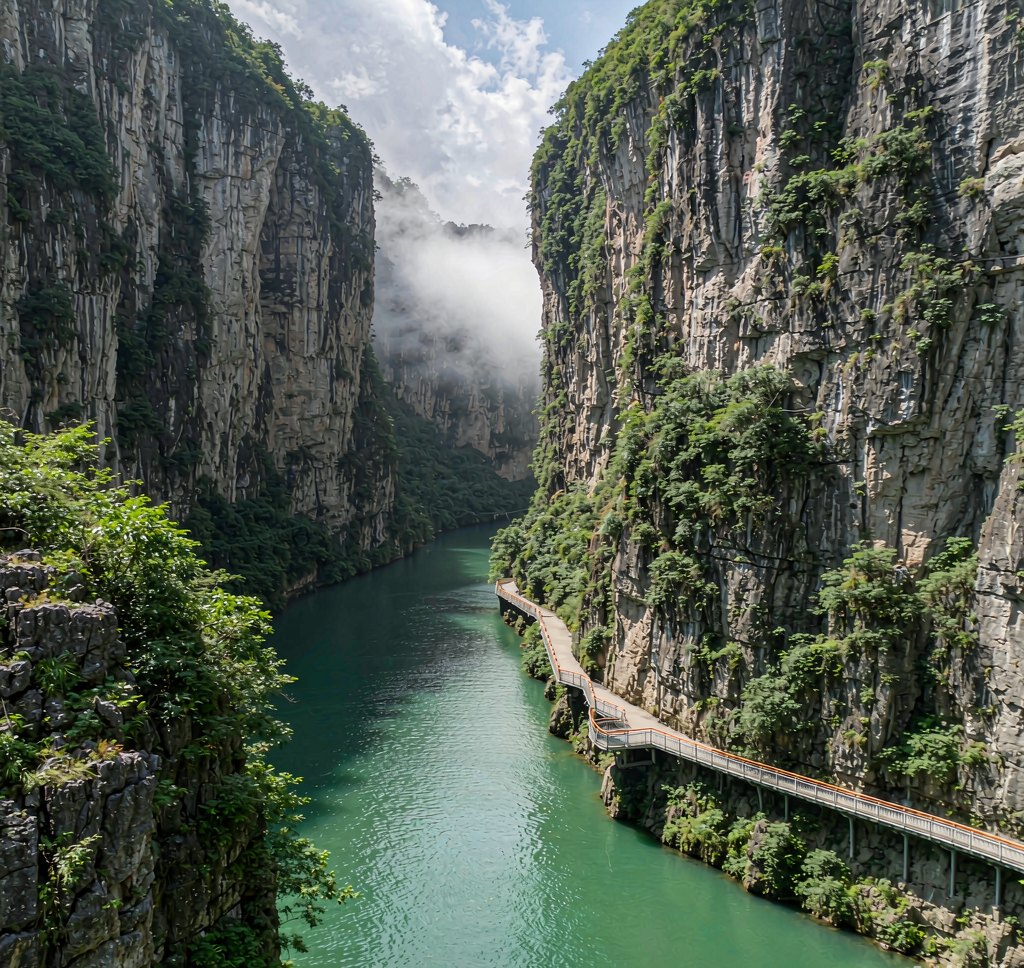
The short answerEnshi is the canyon region of western Hubei: the Grand Canyon and Tenglong Cave are each a full day, they sit in different counties, and the roads between them are mountain roads rather than expressway.
Classic itineraries
Three days: canyon and cave
3 days · 2 nights
The short version, based in Enshi city
- Day 1Arrive, Tusi City in the afternoon, Nv’er City in the evening.
- Day 2Enshi Grand Canyon: cable car up, the cliff walkway, the One Incense Stick, back by late afternoon.
- Day 3Tenglong Cave in Lichuan on the way out, or the Qingjiang boat if you are returning to Enshi.
Five days: add Lichuan
5 days · 4 nights
Anyone combining Enshi with Zhangjiajie or Chongqing
- Day 1–2Enshi city, Tusi City, the Grand Canyon.
- Day 3Road to Lichuan, Tenglong Cave in the afternoon.
- Day 4The Qingjiang or the Tujia villages around Lichuan.
- Day 5On to Chongqing or back to Enshi for the flight.
These are shapes we build regularly, not fixed departures. Move a day, drop a city, add a night — the route is rewritten around your dates, and quoted in writing before anything is booked.
What you will actually see
Enshi Grand Canyon (恩施大峡谷)A karst gorge with a cliff walkway pinned to the rock and the One Incense Stick pillar standing free in the middle of it. The full loop is a long half-day of steps; the cable car takes out the worst of the climb.
Tenglong Cave (腾龙洞)One of the largest cave systems in Asia, with a river running through it and boats inside. The entrance alone is 74 m high. It is in Lichuan, about an hour from Enshi city.
Tusi City (土司城)A rebuilt Tujia chieftain’s compound on a hillside above the city, with the wooden towers and the ceremonial halls. Reconstructed rather than original, and still the clearest explanation of how this frontier was governed.
Nv’er City (女儿城)A Tujia town on the river, built for visitors but inhabited by craftsmen and performers. The evening song-and-dance on the water is the thing to see, and it is better than the word ‘show’ suggests.
The Qingjiang riverGreen water between cliffs, with boat trips that run for two to three hours. This is the landscape the region is actually made of, and the least visited part of it.
Getting there and around
- Enshi Xujiaping (ENH) has flights from Wuhan, Chongqing and Shanghai, and is 20 minutes from the city.
- High-speed rail reaches Enshi from Yichang in about two hours and from Wuhan in about four, which makes it a natural stop between the Three Gorges and the Yangtze.
- The Grand Canyon is roughly 1.5 hours by road from the city; Tenglong Cave is an hour in the other direction, in Lichuan.
- Hubei is covered in full by the 240-hour visa-free transit policy, entered at a designated port — Wuhan is the main one.
Before you go
Steps, not pathsThe Grand Canyon is 8 km of walkway with long flights of stone steps and little shade. Knees are the limiting factor, and the cable car only shortens one direction.
Weather closes the walkwayIce and high wind shut the cliff sections in winter. April to June and September to October are the reliable months; July and August are hot and thundery.
Tujia foodCured pork, pickled vegetables and corn, and a chilli level that is closer to Sichuan than to the coast. Say bu la early if you need to.